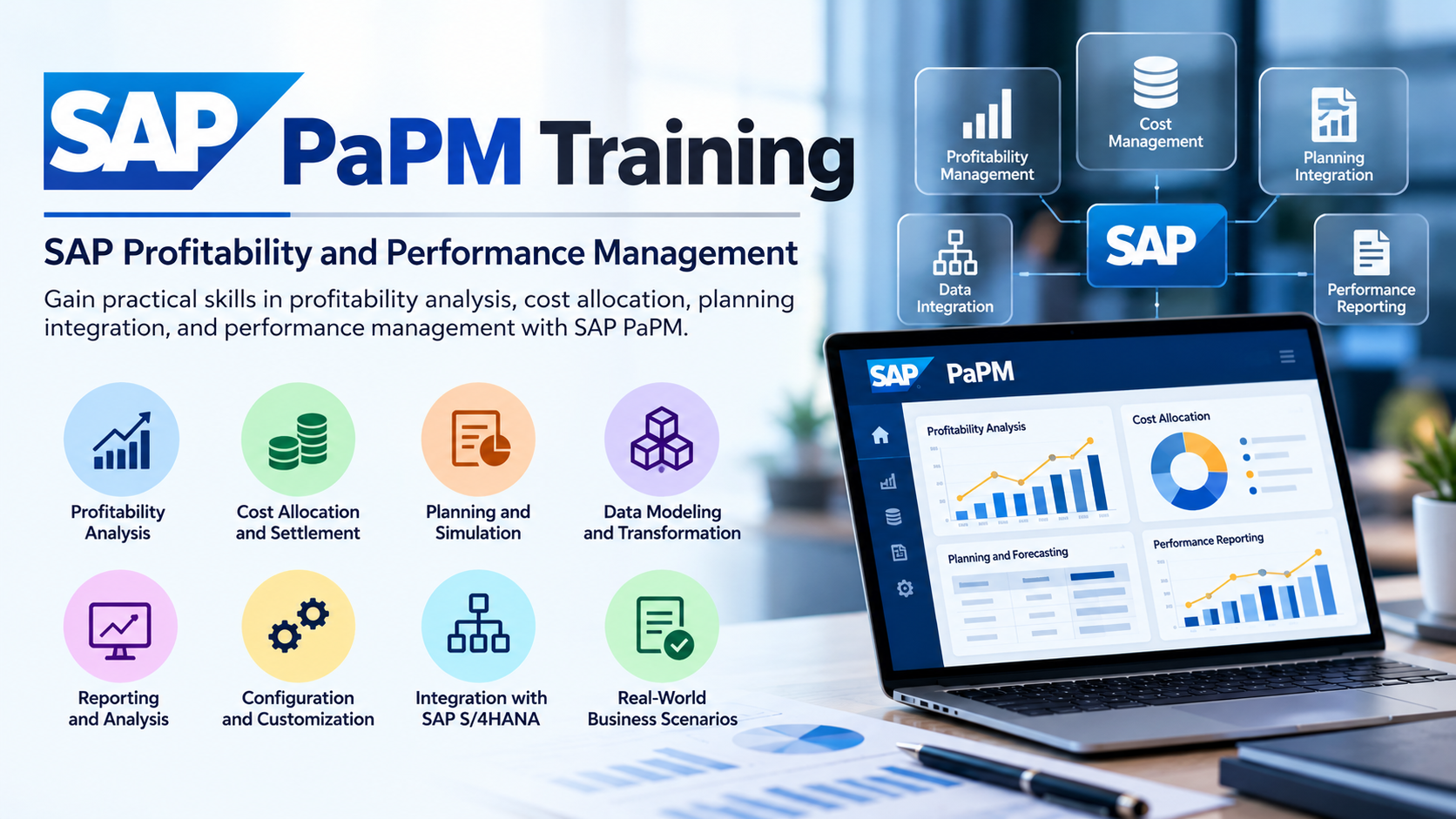
In today's competitive business environment, organizations need advanced solutions to analyze profitability, manage costs, evaluate financial performance, and make informed business decisions. SAP Profitability and Performance Management (PaPM) provides powerful modeling and analytical capabilities that help enterprises gain deeper insights into financial and operational performance.
SAP PaPM Training equips professionals with practical knowledge of profitability analysis, cost allocation, financial modeling, data transformation, planning integration, and performance management. The program covers SAP PaPM architecture, environment configuration, function modeling, calculation processes, reporting, and integration with SAP S/4HANA through practical exercises and industry-relevant business scenarios.
The training is particularly beneficial for SAP consultants, finance professionals, management accountants, financial analysts, and technical specialists seeking expertise in enterprise profitability and performance management solutions.
What Is SAP PaPM?
SAP Profitability and Performance Management (PaPM) is an enterprise application designed to support advanced financial and operational modeling, profitability analysis, cost allocation, and performance calculations.
The solution enables organizations to create flexible calculation models, process large volumes of financial and operational data, and analyze profitability across products, customers, business units, and other dimensions.
SAP PaPM supports sophisticated allocation methodologies, financial simulations, cost modeling, and integration with SAP and non-SAP data sources, depending on the deployment and supported integration capabilities.
By combining data processing, calculation functions, and analytical capabilities, SAP PaPM helps organizations improve financial transparency and support strategic decision-making.
Why Is SAP PaPM Important for Modern Enterprises?
Businesses frequently face challenges in understanding cost structures, allocating shared expenses, identifying profitable products, and evaluating operational performance.
Traditional financial analysis methods may not provide the flexibility required for complex allocation models and multidimensional profitability calculations.
SAP PaPM helps organizations address these challenges through:
-
Profitability Analysis: Evaluate profitability across products, customers, business units, and market segments.
-
Cost Allocation: Distribute direct and indirect costs using defined allocation rules and business drivers.
-
Financial Modeling: Create calculation models for financial and operational performance analysis.
-
Planning and Simulation: Evaluate alternative business scenarios and financial assumptions.
-
Data Integration: Combine relevant financial and operational information from supported data sources.
-
Performance Analysis: Analyze cost structures, profitability drivers, and operational results.
-
Financial Transparency: Improve visibility into allocation methods and calculation outcomes.
Key Topics Covered in SAP PaPM Training
SAP PaPM Training focuses on the functional and technical concepts required to configure calculation models, manage data, perform profitability analysis, and support financial performance management processes.
1. Introduction to SAP PaPM
Understand SAP Profitability and Performance Management fundamentals, business applications, solution architecture, and its role in enterprise financial analysis.
2. SAP PaPM Architecture and Environment
Explore SAP PaPM components, environments, versions, modeling structures, function configuration, and application navigation.
3. Data Modeling and Integration
Learn how SAP PaPM works with financial and operational data, including data sources, fields, joins, data preparation, and integration concepts.
4. SAP PaPM Functions and Modeling
Understand key modeling functions, calculation structures, processing logic, and the configuration of reusable functions for business scenarios.
5. Cost Allocation and Distribution
Explore cost allocation methodologies, allocation bases, sender-receiver relationships, allocation drivers, and multistage allocation scenarios.
6. Profitability Analysis and Calculation
Learn to configure profitability models, calculate contribution margins, analyze revenue and costs, and evaluate profitability across business dimensions.
7. Planning and Simulation
Understand financial simulation concepts, scenario-based calculations, planning integration, and what-if analysis using supported SAP PaPM capabilities.
8. Data Processing and Calculation Execution
Explore calculation execution, processing sequences, dependency management, validation, and performance considerations for complex models.
9. Reporting and Performance Analysis
Gain knowledge of calculation results, analytical outputs, reporting integration, and techniques for interpreting profitability and performance information.
10. SAP S/4HANA and SAP System Integration
Understand integration concepts involving SAP S/4HANA, SAP HANA, financial data sources, and relevant enterprise applications.
11. Model Validation and Troubleshooting
Learn techniques for identifying calculation errors, validating allocation results, analyzing processing issues, and improving model reliability.
12. Practical Business Scenarios
Apply SAP PaPM concepts through business-oriented exercises involving product profitability, customer profitability, shared cost allocation, financial calculations, and performance evaluation.
The exact configuration steps and available functions depend on whether the training uses classic SAP PaPM or SAP PaPM Cloud.
Benefits of SAP PaPM Training
The program helps participants strengthen their understanding of advanced financial modeling and profitability management.
Key benefits include:
-
Gain practical knowledge of SAP PaPM architecture and modeling concepts.
-
Understand cost allocation and profitability calculation methodologies.
-
Learn data modeling and transformation techniques.
-
Explore financial simulations and scenario-based analysis.
-
Understand integration with SAP S/4HANA and relevant data sources.
-
Improve financial performance analysis and reporting knowledge.
-
Learn model validation and troubleshooting techniques.
-
Apply profitability management concepts to enterprise business scenarios.
Who Should Attend SAP PaPM Training?
SAP PaPM Training is suitable for professionals involved in financial management, enterprise performance analysis, SAP consulting, and business transformation.
The target audience includes:
-
SAP FICO Consultants
-
SAP S/4HANA Finance Consultants
-
SAP PaPM Functional Consultants
-
SAP PaPM Technical Consultants
-
Finance and Accounting Professionals
-
Cost and Management Accountants
-
Financial Planning and Analysis Professionals
-
SAP Controlling Consultants
-
Financial Analysts
-
SAP HANA Consultants
-
Enterprise Performance Management Professionals
-
SAP Implementation Consultants
-
Business Process Consultants
Prerequisites for SAP PaPM Training
A basic understanding of financial accounting, management accounting, cost allocation, and profitability analysis is recommended.
Familiarity with SAP FICO, SAP S/4HANA Finance, SAP Controlling, or SAP HANA concepts can be beneficial. Knowledge of data modeling and financial reporting may also help participants understand advanced SAP PaPM scenarios.
Career Opportunities After SAP PaPM Training
Organizations increasingly require financial transparency, detailed profitability insights, and sophisticated cost management capabilities to support business decisions.
SAP PaPM knowledge can support career opportunities in specialized SAP consulting, financial transformation, and enterprise performance management projects.
Relevant career roles include:
-
SAP PaPM Consultant
-
SAP Profitability Management Consultant
-
SAP FICO Consultant
-
SAP S/4HANA Finance Consultant
-
SAP Controlling Consultant
-
Financial Performance Management Consultant
-
SAP Financial Transformation Consultant
-
Cost Allocation Specialist
-
SAP Finance Solution Consultant
Professionals with existing SAP Finance or controlling experience can use SAP PaPM knowledge to expand their expertise in advanced profitability modeling, cost management, and enterprise financial analytics.
Applications of SAP PaPM Across Industries
Banking and Financial Services
SAP PaPM supports product profitability analysis, cost allocation, financial performance calculations, and profitability evaluation across banking services and customer segments.
Manufacturing Industry
Organizations can use SAP PaPM to analyze production costs, allocate overhead expenses, evaluate product profitability, and improve cost transparency.
Retail and Consumer Goods
SAP PaPM helps evaluate profitability across products, stores, sales channels, and customer segments while supporting complex cost allocation requirements.
Energy and Utilities
SAP PaPM can support cost distribution, operational profitability calculations, and financial performance analysis across business units and services.
Why Choose Professional SAP PaPM Training?
Professional SAP PaPM Training provides a structured approach to understanding enterprise profitability and performance management processes. Through instructor-led explanations, configuration demonstrations, and practical business exercises, participants gain exposure to SAP PaPM modeling and calculation techniques.
The program emphasizes financial modeling, allocation scenarios, data integration, calculation execution, and performance analysis to help participants connect technical configurations with business requirements.
Practical learning scenarios allow professionals to understand how SAP PaPM can be applied to cost transparency, profitability analysis, financial calculations, and management reporting.
Conclusion
SAP Profitability and Performance Management is a valuable solution for organizations seeking improved financial transparency, flexible cost allocation, and advanced profitability analysis.
SAP PaPM Training provides professionals with structured knowledge of financial modeling, allocation methodologies, calculation functions, planning integration, reporting, and SAP S/4HANA integration.
By exploring practical business scenarios and enterprise financial processes, participants can strengthen their SAP profitability management expertise and prepare for specialized responsibilities in SAP consulting, financial analysis, and enterprise performance management.